Party Wall Surveyors in London

RICS-regulated party wall surveyors serving London, Surrey and Sussex. We serve statutory notices, prepare schedules of condition and issue Party Wall Awards under the Party Wall etc. Act 1996 — for building owners planning works and for neighbours who have received a notice.

What is a party wall?

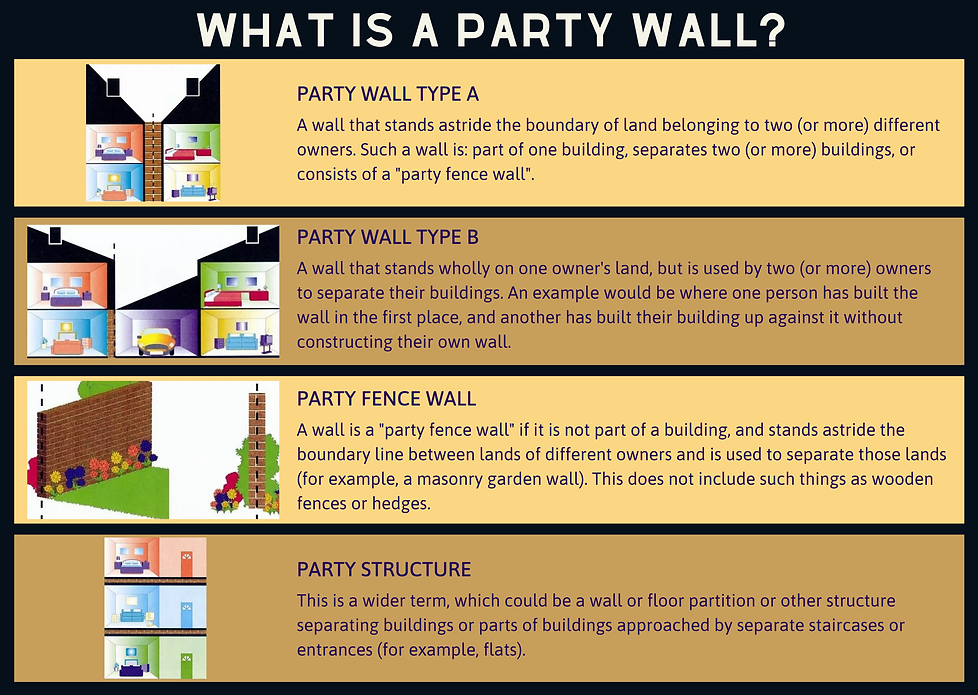
A party wall is a wall that stands astride the boundary between two owners’ land — typically the shared wall between two terraced or semi-detached houses — or a wall on one owner’s land that is used by both. The term also covers party structures (such as floors between flats) and certain boundary walls.

The Party Wall etc. Act 1996 gives owners rights to carry out certain works to these shared elements, and gives neighbours protection against damage. It came into force on 1 July 1997 and applies throughout England and Wales (not Scotland or Northern Ireland). Where your planned work is notifiable, you must serve the correct notice on your neighbour before you begin.

Our role as party wall surveyors is to administer that process impartially: confirming what is notifiable, serving notices, recording condition and, where a dispute arises, drawing up a legally binding Award.

A red brick terraced house with white trim and arched windows sits beside a brown brick house on a residential street.
Infographic explaining party walls with labelled diagrams and brief definitions for Party Wall Type A, Party Wall Type B, Party Fence Wall, and Party Structure.

Do I need to serve a party wall notice?

If your project involves any of the works below, it is likely to be notifiable under the Act and you must serve notice on every adjoining owner before starting. Common triggers include loft conversions, rear and side extensions, basement digs, chimney-breast removal, underpinning and inserting steel beams into a party wall.

Line of junction — Section 1

Building a new wall on or up to the boundary line where none exists. Serve at least one month before work starts.

Party structure — Section 2

Cutting into, raising, underpinning, repairing, demolishing or rebuilding an existing party wall or structure, or inserting a beam or damp-proof course. Serve at least two months before work starts.

Adjacent excavation — Section 6

Excavating near a neighbour’s building within the 3m or 6m distances (below). Serve at least one month before work starts.

No enforcement, but real risk. The Act contains no penalty for failing to serve a notice — but if you start notifiable work without one, an adjoining owner can apply to the court for an injunction to stop the works, plus seek other legal redress. Serving correctly protects your programme as much as your neighbour.

The 3 metre and 6 metre excavation rules

Excavation is one of the most misunderstood triggers. A Section 6 notice is required where you excavate (or excavate for foundations) either:

•  Within 3 metres of a neighbour’s building or structure, where any part of your work will go deeper than their foundations; or

•  Within 6 metres of a neighbour’s building or structure, where any part of your work meets a line drawn downwards at 45° from the bottom of their foundations.

The notice must state whether you propose to strengthen or safeguard their foundations, and be accompanied by plans and sections showing the depth and position of the excavation.

What happens after a notice: consent, dissent and the Award

Once a valid notice is served, your neighbour has 14 days to respond in writing. What happens next depends on their reply:

They consent

If the adjoining owner agrees in writing within 14 days, the works can proceed as notified. It is still wise to record the neighbouring property’s condition first (see below).

They dissent — or stay silent

If they object, or do nothing within 14 days, a dispute is deemed to have arisen under the Act and surveyors must be appointed to resolve it — even if relations are perfectly friendly.

The Party Wall Award

The surveyor(s) produce an Award: a binding document setting out the works, how and when they may be done, and the condition of the property. It is final unless appealed to the county court within 14 days.

Where a dispute is deemed to arise, the owners can appoint a single ‘Agreed Surveyor’ to act impartially for both, or each owner can appoint their own surveyor — in which case the two surveyors select a third surveyor to resolve any point they cannot agree. Blackacre acts in all of these roles.

Why a schedule of condition protects everyone

Before works begin we inspect the adjoining property and prepare a Schedule of Condition — a detailed, photographic record of its existing state, agreed by both sides. It is one of the most valuable documents in the whole process.

If a crack or defect is alleged after the works, the schedule is the reference point that settles whether the building owner’s project actually caused it. It protects the building owner from unfounded claims and gives the adjoining owner genuine reassurance — which is why we treat it as a core part of every instruction, not an optional extra.

Row of Victorian-style red brick terraced houses with bay windows, white trim, and greenery in front, under a clear blue sky.

Who pays for a party wall surveyor?

As a general rule the building owner — the person carrying out the works — pays the surveyors’ reasonable costs, because they are the one seeking the benefit of the project. That usually includes the adjoining owner’s surveyor’s fees where a dispute has arisen.

There are exceptions under Section 11 of the Act: where work is needed because of a defect or disrepair the adjoining owner is partly responsible for, or where the adjoining owner requests additional work for their own benefit, costs can be shared. The Award records who pays for what. We explain more in our guide on who pays for a party wall surveyor.

How we help — building owners and adjoining owners

If you’re planning works

We confirm what’s notifiable, draft and serve the correct notices, prepare the schedule of condition and produce the Award — keeping your project on programme and lawful. Ideal alongside a loft conversion, extension or basement.

If you’ve received a notice

We act as your appointed surveyor, review your neighbour’s proposals, ensure your property is properly recorded and protected, and make sure the Award is fair. Responding within 14 days keeps your options open.

Complex & commercial schemes

Multiple adjoining owners, basements and larger developments — we manage the notices and Awards at scale, and coordinate with our project management and contract administration teams.

Why choose Blackacre

RICS-regulated

An independent, RICS-regulated practice. Notices, schedules and Awards prepared to a professional standard that stands up if challenged.

Impartial & pragmatic

The Act is meant to resolve disputes, not manufacture them. We administer it efficiently and fairly, keeping neighbours on good terms wherever possible.

London, Surrey & Sussex

Local surveyors who know the housing stock and the London boroughs — and who also handle building surveys and right to light where your project needs them.

Party wall questions, answered

If your works are notifiable and your neighbour consents in writing within 14 days, you may not need surveyors at all. But if they dissent or don’t respond, a dispute is deemed to arise and a surveyor must be appointed to produce an Award. Even when consent is given, a surveyor-prepared schedule of condition is strongly advisable to protect you against later damage claims.

The Act carries no criminal penalty for failing to serve notice, so it isn’t ‘illegal’ in that sense. However, starting notifiable work without following the Act leaves you exposed: an adjoining owner can seek a court injunction to halt the works and pursue other legal remedies, which is far more costly and disruptive than serving notice properly.

Usually the building owner carrying out the works pays the reasonable surveyors’ costs, including the adjoining owner’s surveyor’s fees where a dispute has arisen. Section 11 of the Act allows costs to be shared in specific cases — for example where the work is needed due to disrepair the neighbour is responsible for, or where they request extra work. The Award sets out who pays.

Under Section 6, you must serve notice if you excavate within 3 metres of a neighbour’s building or structure and any part of your excavation goes deeper than their foundations. A separate 6 metre rule applies where deeper excavations meet a 45-degree line drawn down from the base of their foundations. Both are common with basements and extension footings.

A party wall notice is valid for one year from the date it is served, so you should not serve it more than about a year before you intend to start. You must give the correct notice period first — two months for works to an existing party structure, or one month for a new boundary wall or an excavation.

You can serve notices yourself, and if your neighbour consents in writing you may not need a surveyor. But once a dispute is deemed to arise, the Act requires an impartial surveyor (or surveyors) to draw up the Award — you cannot lawfully self-certify that. Getting the notices and schedule right at the outset also avoids errors that can invalidate the process.

An Award (sometimes called a party wall agreement) is the binding document produced by the appointed surveyor(s). It authorises the notifiable works, sets out how and when they may be carried out, records the condition of the adjoining property and allocates costs. It is final and binding unless either owner appeals to the county court within 14 days of it being served.

No. Party wall matters concern physical works to shared walls and nearby excavation under the 1996 Act. Right to light is a separate private legal right to daylight through defined apertures, acquired over time and enforced through the courts. A project can raise both issues at once, and we can advise on each.

Key contact

A man with short hair and light stubble, wearing a suit jacket and collared shirt, poses for a professional headshot against a plain background.

Ben Salvage MRICS C.Build E MCABE

Director | Chartered Building Surveyor

Ben leads Blackacre’s party wall work, acting as building owner’s surveyor, adjoining owner’s surveyor and agreed surveyor across London, Surrey and Sussex. Get in touch to discuss your notice, works or Award.

e: ben.salvage@blackacresurveyors.com
t: 07515 441468

Serving a notice or received one? Talk to us.

Whether you’re planning a loft conversion, extension or basement, or your neighbour has served a notice on you, we’ll administer the Party Wall etc. Act 1996 properly and protect your property. Free, no-obligation quote.